

202 means your event is safe, why one slow endpoint doesn’t slow the rest, and where the delivery log comes from.
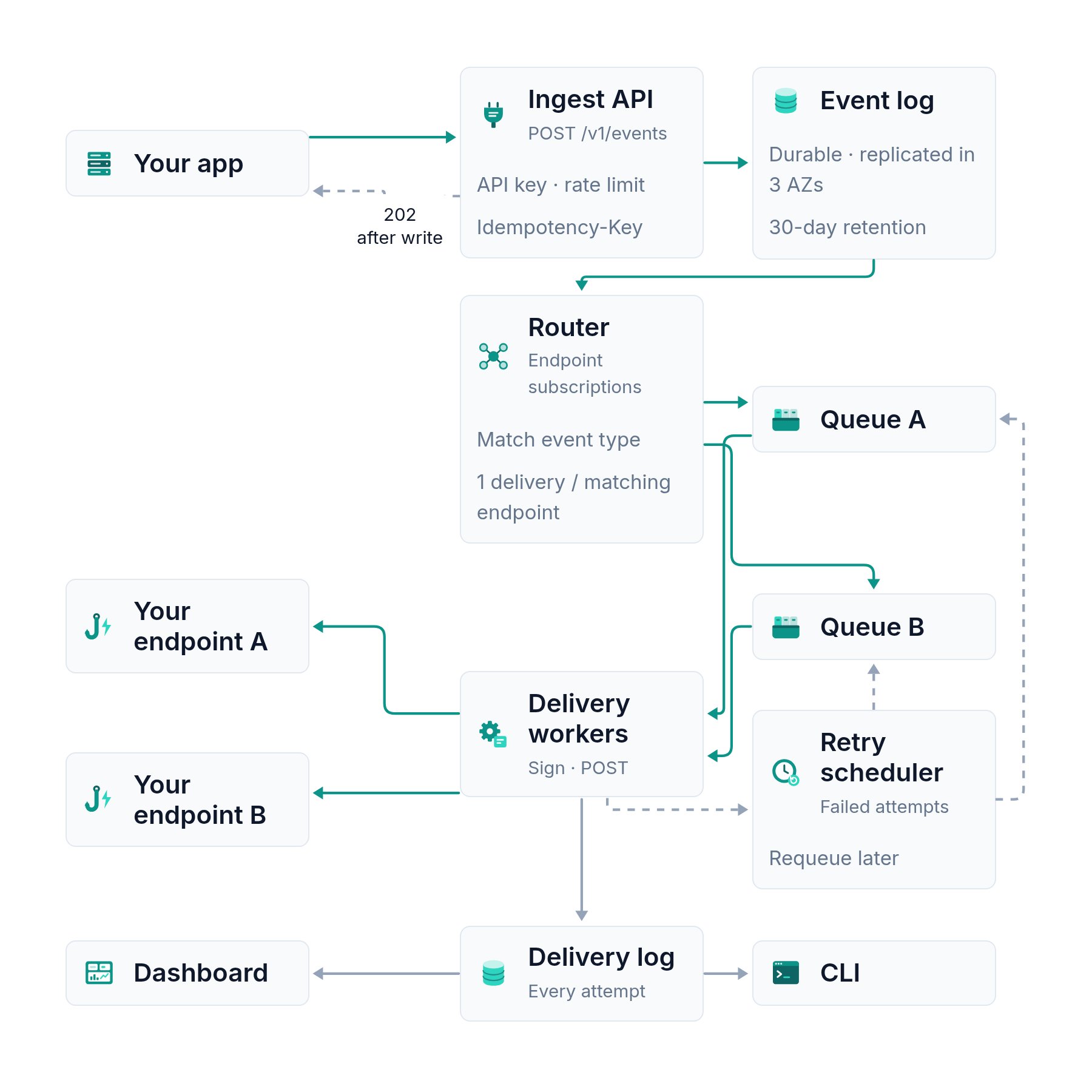
An event is written once to the event log, then becomes one delivery per subscribed endpoint, each with its own queue.
Ingest
The Ingest API checks your key, your rate limit and your idempotency key, then writes the event to the event log. It answers202 only after the write is acknowledged, so an event you got a 202 for is not lost.
Event log
The event log is replicated across three availability zones and keeps events for 30 days. You can fetch any event in that window withGET /v1/events/{id}.
Routing
The router reads new events and matches each against your endpoints’ subscriptions. It creates one delivery per matching endpoint. A subscription change applies to events sent after it; events already routed keep their deliveries.Delivery
Each endpoint has its own queue. Delivery workers take deliveries from each queue, up to the endpoint’s concurrency limit (10 by default), sign them and send them. A failed attempt goes to the retry scheduler, which puts it back on the same queue when its next attempt is due. Because queues are separate, an endpoint that times out on every request only delays its own deliveries.Delivery log
Every attempt is recorded with its status code, response time and the first 4 KB of the response body. The dashboard andrelay deliveries read from it. Attempts are kept for 30 days.